
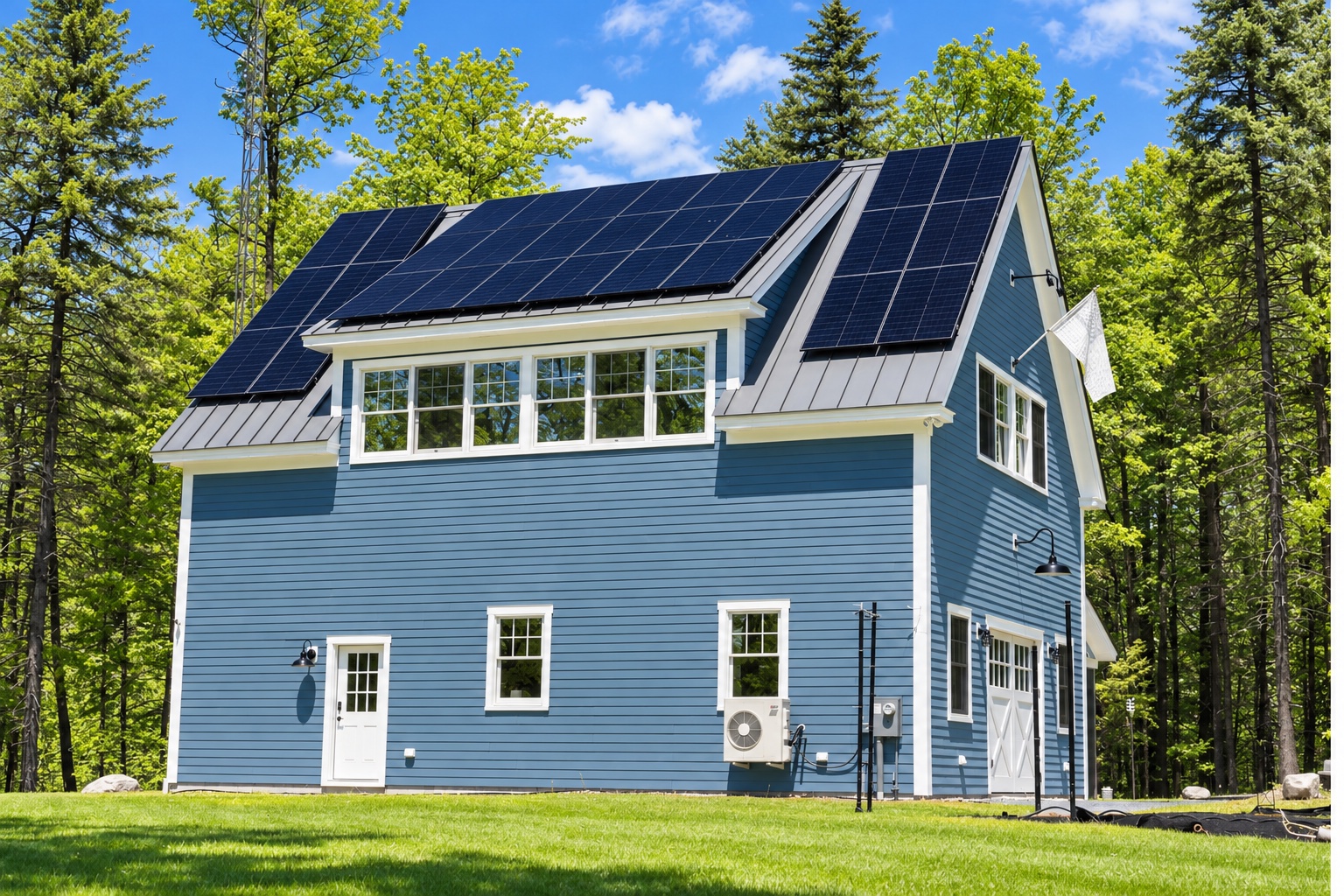
Buying a New Hampshire home with solar panels does not always mean buying the panels. If the seller owns the system, ownership generally transfers with the property when the sale documents provide for it. If a solar company owns the equipment under a lease or power purchase agreement, buying the house does not automatically make you the equipment owner. A financed system also requires a clear plan for the remaining debt.
The safest starting point for evaluating NH home solar panels is to separate three questions: Who owns the equipment? Who owes the payments? Who receives the utility credits? Those answers may involve different agreements and different companies.
Content reviewed October 15, 2026.
Who owns NH home solar panels when a house is sold?
Start with the original purchase, financing, lease, or power purchase agreement. A listing description such as "solar included" is not enough to establish ownership or explain the buyer's obligations.
| Solar arrangement | Equipment owner | Main issue before closing |
|---|---|---|
| Owned outright | Homeowner | Confirm transfer and any recorded interests. |
| Purchased with a loan | Usually homeowner | Resolve payoff or permitted loan assumption. |
| Solar lease | Third-party company | Obtain contract and transfer approval. |
| Power purchase agreement | Third-party company | Review energy price and assignment terms. |
What is the difference between a solar loan, lease, and PPA?
Solar loan: Financing used to purchase the system. Ownership and debt are separate issues, so an unpaid balance must be addressed even when the seller owns the panels.
Solar lease: An agreement to use equipment owned by another company, generally in exchange for scheduled payments.
Power purchase agreement, or PPA: An agreement to purchase electricity produced by a third-party-owned system, typically priced per kilowatt-hour. A kilowatt-hour, or kWh, measures energy used or generated.
What happens to a solar loan when you buy a NH home?
A seller's solar loan does not become your personal debt simply because you buy the house. The transaction needs a documented solution. Common approaches are a seller payoff or a buyer assumption, when the solar lender permits it and the buyer qualifies.
Ask for a current payoff statement rather than relying on the balance shown on an older bill. Have the closing team confirm which releases or other documents are required and who will deliver them. If you are considering assumption, review the interest rate, remaining term, monthly payment, and any scheduled payment changes.
A useful negotiation question is: "Will the seller deliver the system paid off, or is the purchase price based on my taking over a separate obligation?" Resolve that question before treating solar as an added benefit in your offer.
Can a solar lease or PPA transfer to a home buyer?
A transfer may be possible, but the contract controls the process. Request the complete agreement and amendments, then ask the provider to identify buyer eligibility, transfer fees, approval steps, and timing. Do not assume the seller can cancel an agreement without cost.
Use these questions to compare the actual obligations:
- How many years remain, and does the payment or energy rate increase each year?
- Who pays for maintenance, roof-related removal, and reinstallation?
- Is a system purchase allowed now, and is the quoted amount a true ownership buyout?
- What happens at the end of the agreement: renewal, purchase, or removal?
Prepayment and ownership are different. Paying future lease charges in advance may leave the company as the equipment owner. Obtain written confirmation of exactly what any proposed payment accomplishes.
Can solar panels affect mortgage approval or the appraisal?
Yes. Give your mortgage lender the solar paperwork early. Under Fannie Mae guidance, lease payments generally count toward debt-to-income qualification, subject to specific exceptions. A PPA payment based solely on energy produced may be excluded. Third-party-owned panels cannot be included in the property's appraised value under that guidance. Your loan program and lender must determine the applicable treatment.
A UCC filing is a public notice related to an interest in specified property. A solar filing is not automatically a lien on the entire home. Have the title professional and lender determine what it covers and whether a release, subordination, or other action is needed. Equipment-only precautionary filings for leased or PPA systems can be acceptable under Fannie Mae rules when its conditions are met.
Does NH net metering transfer when you buy a house?
Net metering is a billing arrangement that compensates eligible customers for electricity exported to the grid. It is separate from ownership of the panels and separate from a solar lease or loan.
New Hampshire rule Puc 908.10 provides for transfer of a customer-generator's certificate to operate when the property is conveyed, if the new owner supplies updated information and a written agreement to operate and maintain the facility under applicable requirements. Coordinate that process with the electric distribution utility.
Before closing, request written answers to these questions:
- Which net-metering tariff applies to this specific system?
- What forms are needed to register the new owner and establish the account?
- Will existing tariff terms continue, and what conditions apply?
- How will the seller's unused credits be handled when the account closes?
Do not assume an account credit transfers like a kitchen appliance. Ask the utility to explain the balance treatment and confirm it in the closing plan. Where grandfathering applies, NH rules allow qualifying new owners to continue under applicable existing terms. The utility should verify the status of the actual installation.
How do you calculate the cost of NH home solar panels?
Review at least 12 months of utility bills alongside solar production records. Compare a full year because one sunny month does not show the whole picture. Your own electric use may differ from the seller's, especially if you plan to add an electric vehicle, heat pumps, or more occupants.
Buyer budgeting framework: remaining utility charges + solar loan, lease, or PPA payments + expected maintenance and insurance costs, minus separately payable solar revenue. Count each credit or benefit only once.
Illustrative example, not a savings forecast: If a household pays $95 per month to the utility after solar credits and $140 on a solar lease, its combined payment is $235 per month before other costs. A listing that mentions only the $95 utility bill leaves out a major expense.
Ask for a year-by-year payment schedule if the contract has an escalator. Compare several usage and rate scenarios rather than assuming electricity prices will rise by a fixed percentage. The budget should still make sense if expected savings are smaller than advertised.
Who receives solar renewable energy certificates after closing?
Renewable energy certificates, or RECs, represent renewable generation attributes and can have financial value. Panel ownership alone does not establish whether those rights have already been assigned or sold. Request any REC agreement and written transfer instructions. Include projected REC income in your budget only after confirming your right to receive it.
What solar inspections and documents should NH buyers request?
Treat the solar review as its own part of due diligence. A general home inspection may not answer detailed electrical, production, or contract questions. Consider a qualified solar contractor and a roof specialist where appropriate.
Use this buyer checklist to build a complete file:
- Ownership: Original purchase documents or the complete lease/PPA, including amendments and any buyout terms.
- Debt and title: Loan statements, payoff instructions, assumption approval if applicable, and identified filings or releases.
- Installation: System age, equipment specifications, available permit and inspection records, and utility permission to operate.
- Performance: Production history, monitoring records, error messages, and explanations for unexplained outages or declines.
- Roof condition: Roof age, evidence of leaks, mounting condition, and a written estimate for removal and reinstallation if replacement is approaching.
- Warranty and service: Equipment and workmanship coverage, transfer requirements, fees, and the current service contact.
- Insurance: Confirmation of coverage, deductibles, and whether the system changes your premium or required endorsements.
- Battery storage: Separate ownership or financing documents, age, condition, warranty, and an explanation of which circuits it can support.
The U.S. Department of Energy notes that residential panels commonly last 20 to 25 years and string inverters often last 10 to 15 years. These are planning ranges, not promises for a particular installation. Compare component ages with remaining warranty coverage and an independent condition assessment.
Do NH home buyers receive a solar tax credit or exemption?
Buying an existing home with previously installed panels does not create a new federal Residential Clean Energy Credit for that used equipment. The IRS also states that the Section 25D credit is unavailable for property placed in service after December 31, 2025. Do not include a new 30% homeowner credit in a 2026 purchase budget based on older solar advertising.
Property taxes are a separate issue. RSA 72:62 allows New Hampshire cities and towns to adopt a solar exemption from assessed value. Availability and administration are local. Ask the municipal assessing office whether an exemption applies, what amount is recognized, and what the new owner must file. A seller's prior tax bill does not establish your eligibility.
For a specific purchase, have the closing attorney review legal obligations, the lender confirm loan treatment, and a tax professional address tax eligibility. Each answers a different part of the ownership question.
Frequently asked questions about NH home solar panels
Do solar panels automatically come with a New Hampshire house?
Seller-owned panels generally convey when included in the sale. Third-party-owned equipment remains subject to its contract. Confirm ownership and the agreed transfer in writing.
Do I have to assume the seller's solar lease?
Buying the property does not itself mean you have accepted every solar obligation. However, the existing contract can affect how the seller completes the sale. Negotiate an approved transfer, permitted buyout, or other documented solution before committing.
Can I buy a NH home if the solar panels are not paid off?
Yes, if the parties and relevant lenders resolve the balance and transfer requirements. Obtain written payoff or approved assumption terms and confirm any required releases.
Are solar panels guaranteed to increase a home's value?
No fixed premium applies to every home. Ownership, condition, remaining life, local comparable sales, and contract obligations matter. Avoid assigning value based only on the seller's installation cost.
Will I still receive an electric bill with solar panels?
Usually. You may still buy electricity and pay fixed charges. If the system has financing, a lease, or a PPA, that separate payment also belongs in your budget.
What should I receive at closing for a solar home?
Use a transaction-specific handoff list: ownership or assignment documents, required payoff and release evidence, utility transfer instructions, warranties, service contacts, and monitoring access. Confirm which items must be completed before funds are released.
What should you verify before buying a NH home with solar?
For NH home solar panels, a sound purchase decision starts with documented ownership, a clear payment plan, verified utility treatment, and an understanding of the equipment's condition. Resolve those four items before counting solar as a financial advantage of the home.
Sources
U.S. Department of Energy, A Consumer's Guide to Buying a House with Solar Panels, Federal Trade Commission, Solar Power for Your Home, Consumer Financial Protection Bureau, Issue Spotlight Solar Financing, Fannie Mae, Selling Guide B2-3-04, New Hampshire Puc 900 including Puc 908.10 and Puc 903.02, New Hampshire RSA 72:61-64, Internal Revenue Service, Residential Clean Energy Credit
Articles on this blog are for general educational purposes and are not individualized legal, tax, lending, or real estate advice. Markets, rules, and programs change, and every situation is different. Always consult a qualified professional about your specific circumstances.